
Open File Discovery
An adoption file can hold names, dates, medical history, decisions, descriptions, photographs, omissions, and language written about your life by people you may never have met.
Reading it can add information and alter the story that existed before it. Beyond the Sun offers adoption-fluent support before, during, and after the file is opened.
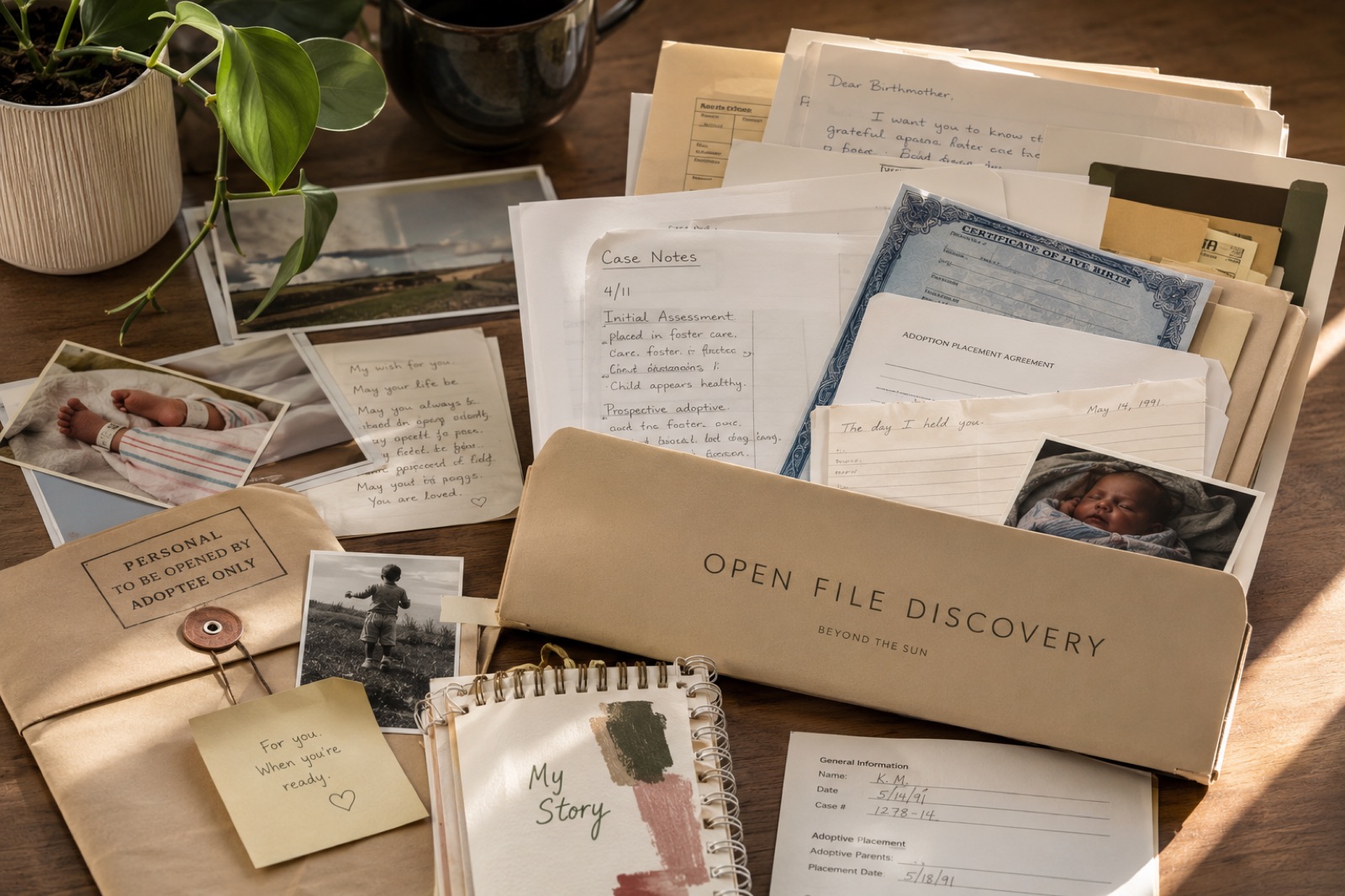
A file can alter the shape of what you know.
Opening records is not a neutral transfer of information. A single sentence can confirm something long sensed, contradict what was previously told, introduce an unknown person, or create questions the file cannot answer.
Information arrives with context.
Records often combine factual details with interpretation, institutional priorities, missing information, and terminology from another time. Careful reading makes room for both what the file offers and what it cannot establish.
Recognition
A name, photograph, familiar trait, location, or sentence may create an immediate sense of connection.
Contradiction
Records may conflict with family stories, earlier explanations, personal memory, or one another.
Absence
Missing pages, sealed details, vague language, and unanswered questions can carry their own weight.
Institutional language
A file may describe a person through the priorities and assumptions of the system that created it.
What is written matters. What was omitted matters. Who had the power to write it matters.
What may become active
Responses can be immediate, delayed, layered, or seemingly contradictory. No single reaction defines what the discovery means.
Identity & origin
New details may reshape how a person understands resemblance, lineage, culture, family, and self.
Grief, anger, relief & recognition
Different responses can exist together, shift over time, or emerge long after the file is read.
Family relationships
Discovery may affect loyalty, trust, privacy, belonging, and conversations across the adoption constellation.
Medical & genetic meaning
Health information may offer context, introduce concern, or reveal how much remains unknown.
Contact & reunion decisions
Information may create urgency to reach out, a need for distance, or a wish to gather more before deciding.
Story integration
The work may include separating fact from interpretation and making room for more than one account of the same history.
Care shaped around the point you are in.
You may be preparing to request records, holding a sealed envelope, reading material for the first time, revisiting information years later, or responding to an unexpected discovery. The work begins there.
Prepare without scripting the outcome.
- Clarify what is known, expected, and uncertain
- Choose pacing, setting, privacy, and support
- Name boundaries around sharing and contact
- Create space after the reading rather than rushing into the next task
Make room for the full impact.
- Pause without losing the thread
- Separate documented fact from opinion or interpretation
- Track questions, contradictions, images, and missing pieces
- Use conversation, artmaking, writing, mapping, or quiet reflection
Integrate before deciding what comes next.
- Revisit details after the first impact has shifted
- Consider what remains private and what may be shared
- Approach search or contact decisions without urgency taking over
- Build language for family, partners, children, or professionals
Open file discovery is not the same as reunion.
Finding information may lead toward contact. It may also lead toward delayed contact, no contact, private meaning-making, more research, or a decision that remains open.
Information does not create an obligation to act. Contact, relationship, disclosure, and access are separate decisions.
“Not now” does not have to mean “never.” New information can be held before it is acted upon.
For the people living inside the discovery.
Open file work can involve one person, several relationships, or an entire family system. Support remains centered on the person whose records, history, and identity are being opened.
Therapy, coaching, and collaborative support.
The method can include conversation, creative processing, structured record mapping, shared sessions, preparation for disclosure or contact, and support with family communication.
The $125 file-opening fee, explained.
Opening a file is careful work. The fee covers the time it takes to do it properly:
- Locating and retrieving your record from the protected archive.
- Reviewing every page before it is released.
- Redacting where required — when the law or another person’s privacy calls for it.
- Preparing the file securely for you to receive.
- Walking through what the file holds — and what it may mean — with support available before, during, and after.
Open File Discovery FAQ
Do I need to read everything at once?
No. The file can be read in sections, revisited over time, or paused. Pacing is part of the decision, not a test of readiness.
What if the records contradict what I was told?
Contradiction can affect trust, memory, identity, and family relationships. The work can include mapping each account, identifying what is documented, and naming what remains uncertain without forcing a single tidy version.
Can another person attend the session?
Shared sessions may include a partner, parent, family member, or another significant support person when that structure fits the work and keeps the adoptee’s needs centered.
Does Beyond the Sun provide search or legal services?
Beyond the Sun provides therapeutic and coaching support. Search, legal, medical, DNA, and genealogy questions may require other professionals; care can be coordinated alongside those services.
Your file can be opened at your pace.
With room for what it gives, what it changes, what it confirms, and what it cannot answer.